
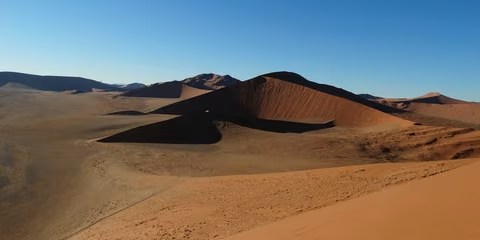
Great Sand Dunes, Colorado
For: First-time visitors to Great Sand Dunes who want to hike the dunes, and who need the park fee, the Medano Creek season and the way in from Denver or Alamosa. Great Sand Dunes is open 24 hours a day, year round; entry is USD 25 a private vehicle, with no reservation or timed entry. The park is 37 miles from Alamosa and 234 to 242 miles from Denver, and the sand surface can reach 150 F on summer afternoons.
Entry rules depend on your passport. The rules for UK, Canadian and Australian passports are under Before you go on the United States page.
- Currency
- US dollar[12]Notes of 1, 2, 5, 10, 20, 50 and 100 dollars are issued by the Federal Reserve; it is government policy that all designs remain legal tender whenever they were issued.
- Time zone
- UTC-7 (MST) / UTC-6 (MDT)
- Advisories
- UK: FCDO does not advise against travel to any part of USACanada: Level 1Each government's advice
Quick answers
- How do I get from the airport?
- DEN: Car: Rental cars are available at the Denver, Colorado Springs and Albuquerque airports, which the Park Service says have more commercial airlines. Checked .
- Every option is under Airport to city.
- Is it safe?
- Advice from each government for United States:
- UK: FCDO does not advise against travel to any part of USA. Checked .
- Canada: Level 1. Checked .
- Do I need a visa?
That depends on your passport. The rules for US, UK, Canadian and Australian passports are in the United States guide.
i
The one thing
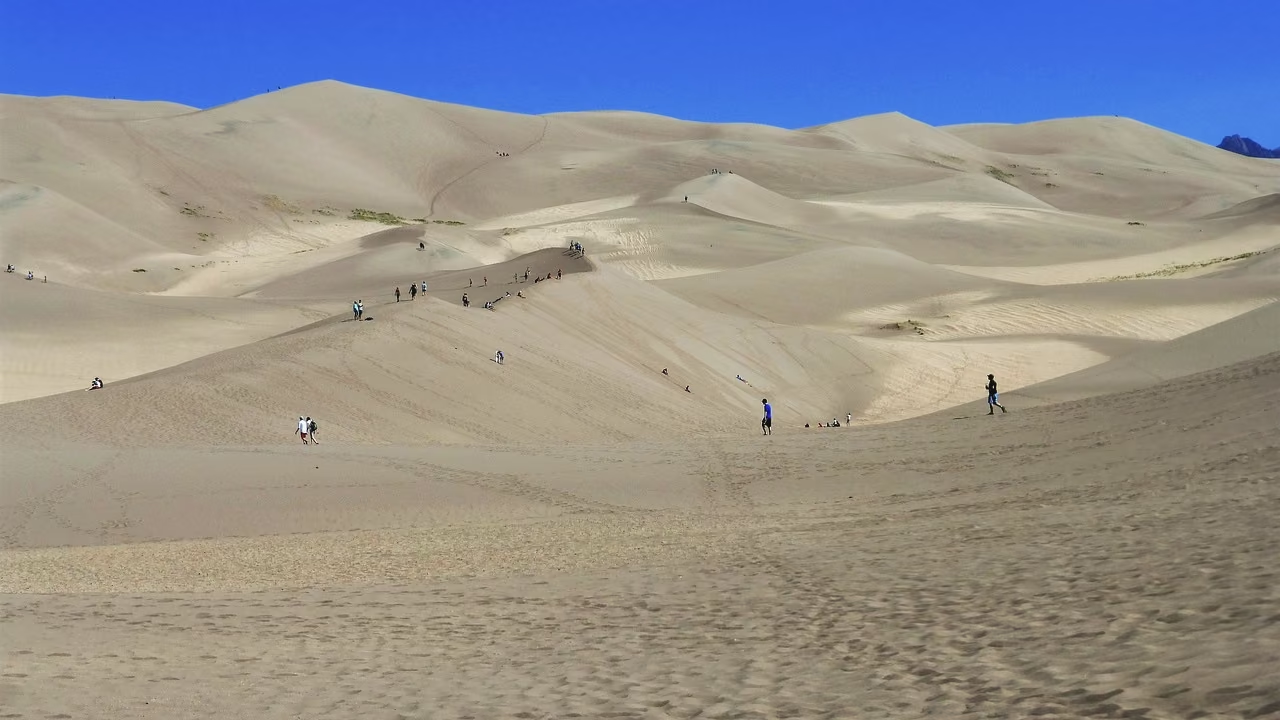
Hiking to High Dune
The Park Service gives High Dune on the first ridge as 688 feet (209 m) from base to top, with an average round trip of 2 hours over 2.5 miles (4 km). It allows up to 4 hours if you are not acclimated to the elevation. The dunes have no trails.
Cross Medano Creek bed from the Dunes Parking Area and climb the first ridge; the dunes have no marked trails, so you can go anywhere on the dunefield. The Park Service gives 2 hours round trip over 2.5 miles, or up to 4 hours if not acclimated to the elevation and thin air. High-top boots with long pants keep sand out; sandals chafe.[1][2] Price: USD 25 per private vehicle, covering all occupants; USD 20 per motorcycle (valid 7 days); USD 15 per person aged 16 and over on foot or by bicycle. Children under 16 on foot or bicycle need no pass. Vehicle and motorcycle fees are credit or debit only at the entrance station.[3] Hours: The Park Service says the park is open 24 hours a day, 7 days a week, year round. In summer the Park Service says to hike in early morning or evening, because the sand surface can reach 150 F on afternoons and dangerous thunderstorms can develop; it warns that lightning strikes can be fatal.[4][1][2] Current conditions Booking: No reservation is needed. The Park Service says there are no timed entries and no visitor limits, and advance purchase of a pass is optional.[3] Booking details on the official site
- JanHigh 33°F 1°CLow 11°F -11°C
- FebHigh 39°F 4°CLow 16°F -9°C
- MarHigh 49°F 9°CLow 24°F -5°C
- AprHigh 56°F 13°CLow 29°F -2°C
- MayHigh 66°F 19°CLow 38°F 3°C
- JunHigh 77°F 25°CLow 48°F 9°C
- JulHigh 81°F 27°CLow 52°F 11°C
- AugHigh 78°F 26°CLow 50°F 10°C
- SepHigh 72°F 22°CLow 44°F 6°C
- OctHigh 60°F 15°CLow 33°F 0°C
- NovHigh 46°F 8°CLow 22°F -6°C
- DecHigh 34°F 1°CLow 12°F -11°C
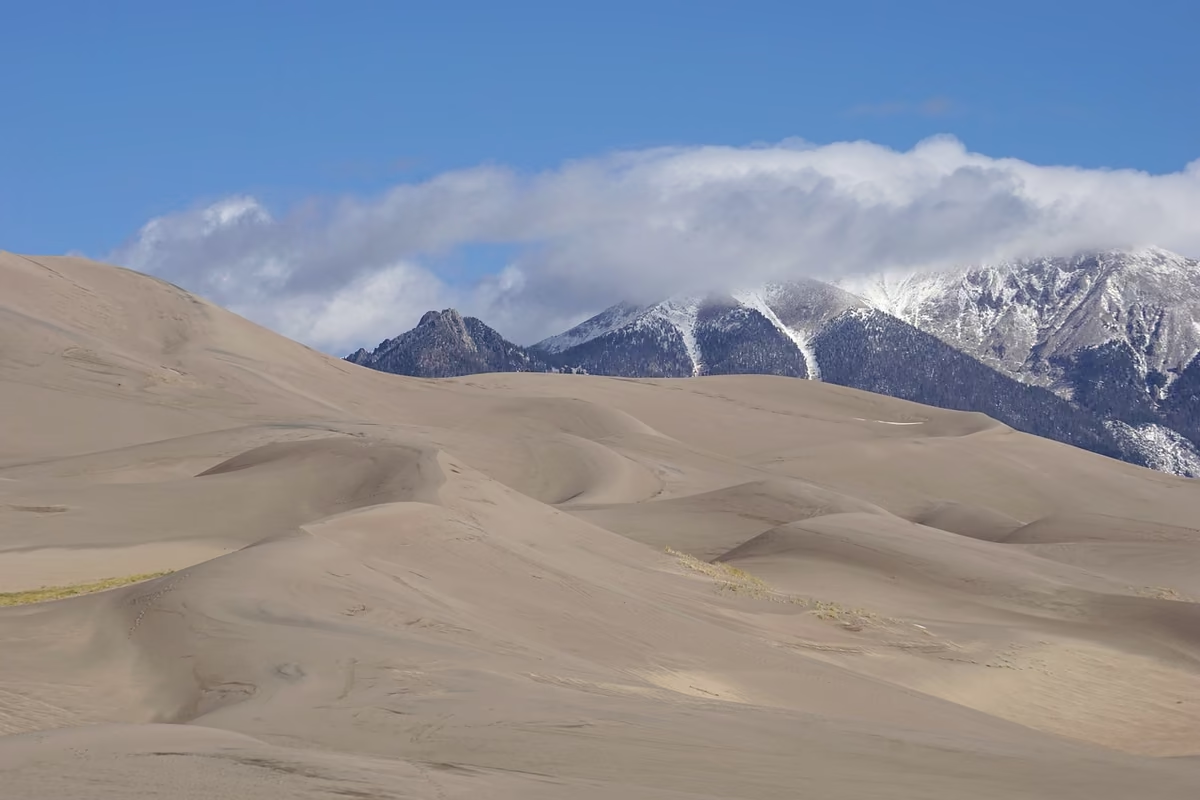
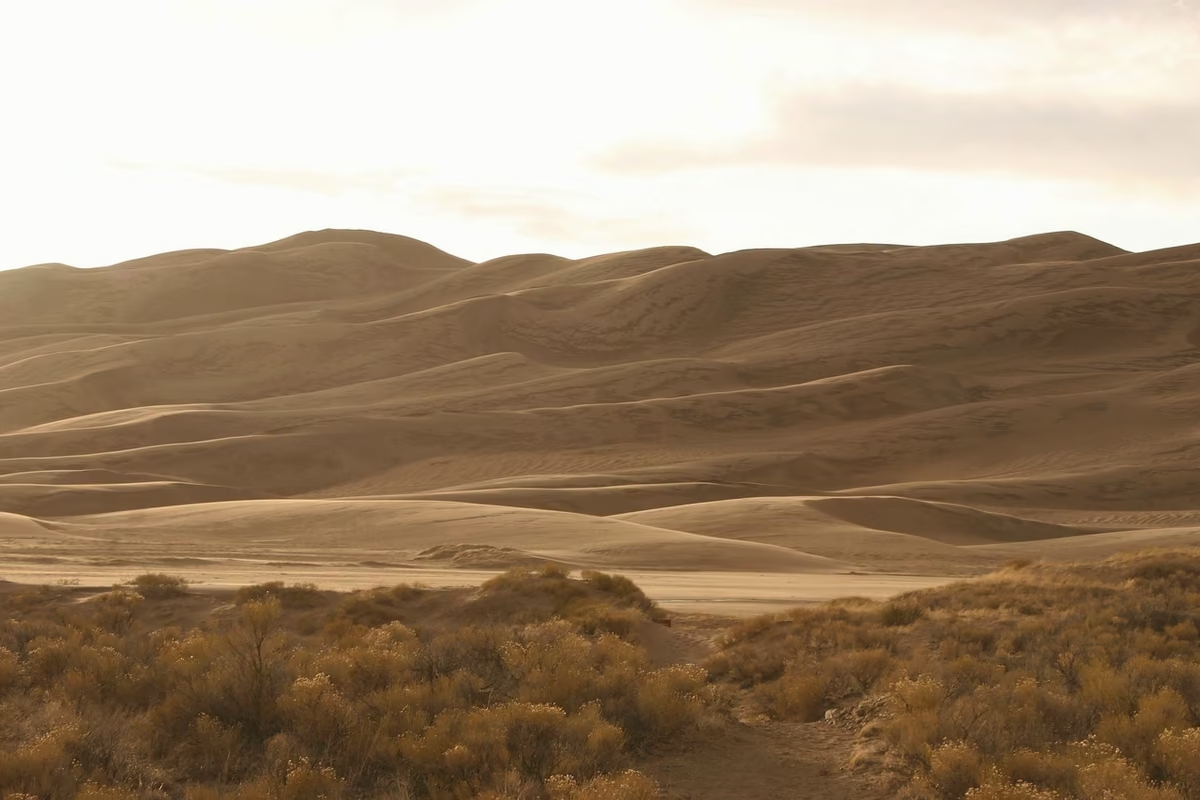
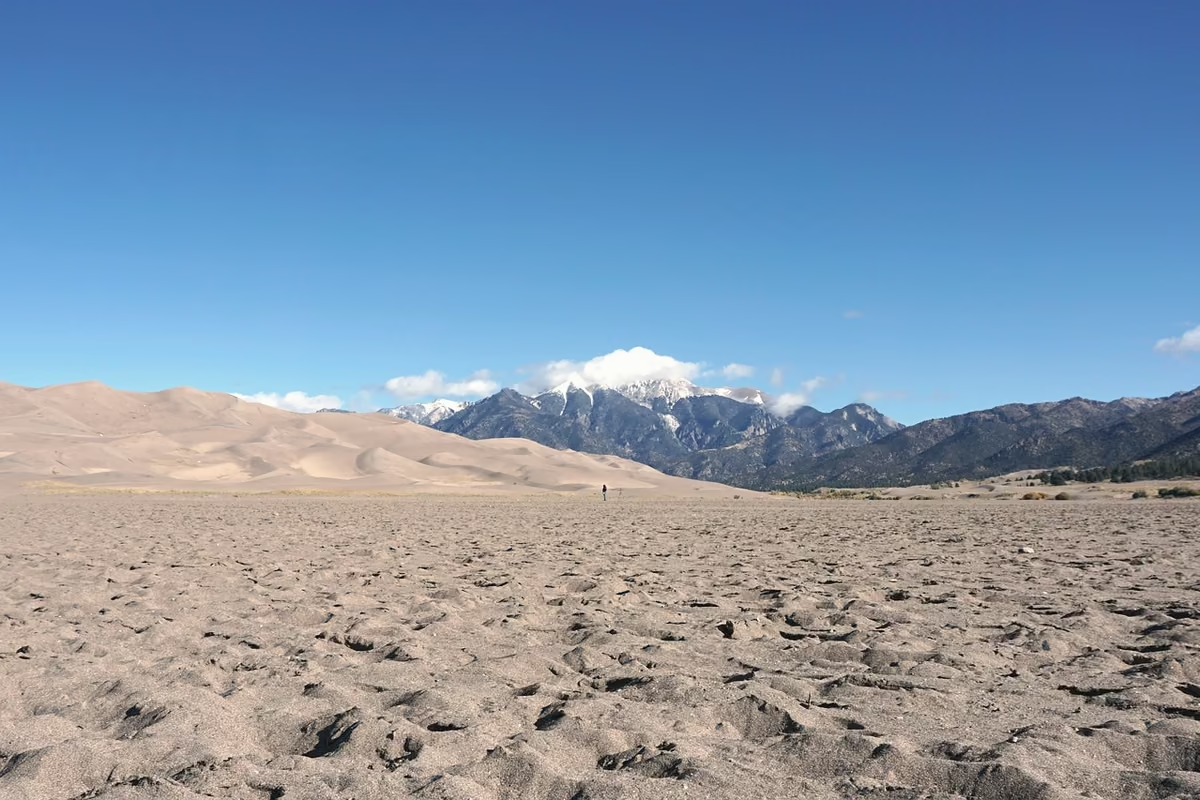
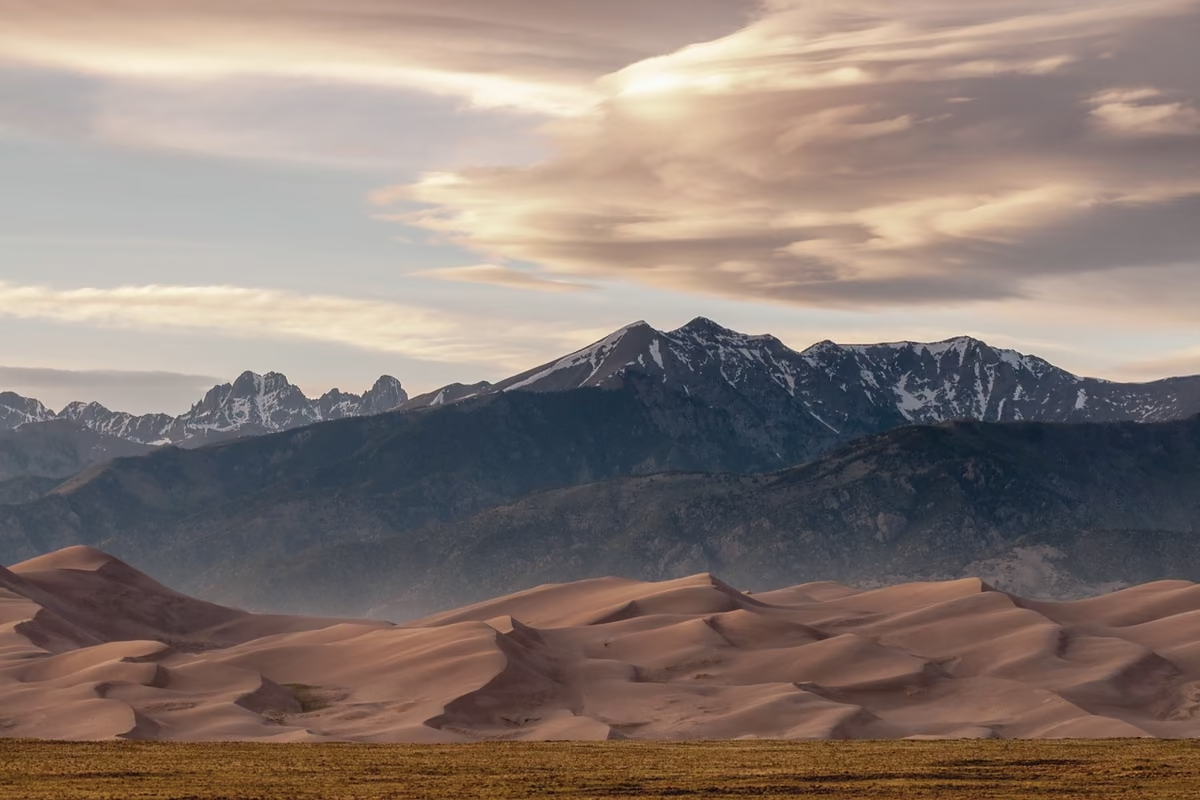
Great Sand Dunes in pictures
4 photographs, each with its photographer and licence.
Jump to
Highlights
Star Dune hike
The tallest dune in the park is 736 feet (224 m) from base to summit. The Park Service gives about 6 hours over 6 miles (9.6 km) round trip, and up to 9 hours if you are not acclimated. It recommends starting from the base along the Medano Creek bed, which is more direct with less up and down.
USD 25 per private vehicle, covering all occupants; USD 20 per motorcycle (valid 7 days); USD 15 per person aged 16 and over on foot or by bicycle. Children under 16 on foot or bicycle need no pass. Vehicle and motorcycle fees are credit or debit only at the entrance station.[3]The Park Service says the park is open 24 hours a day, 7 days a week, year round. The Park Service advises hiking in early morning or evening in summer to avoid sand heat and lightning.[4][1] Current conditionsNo reservation is needed; there are no timed entries or visitor limits. The dunes have no trails.[3][1]Official site
Sand sledding and sandboarding
Sandboarding, sledding and skiing are allowed anywhere on the dunefield away from vegetated areas. The small and medium slopes are at least 0.7 mile (1 km) from the main Dunes Parking Area, and the top of the first high ridge is 1.25 miles away. The Park Service suggests the first high ridge rather than near Castle Creek, where firm creekbed sand lies at the bottom.
USD 25 per private vehicle, covering all occupants; USD 20 per motorcycle (valid 7 days); USD 15 per person aged 16 and over on foot or by bicycle. Children under 16 on foot or bicycle need no pass. Vehicle and motorcycle fees are credit or debit only at the entrance station.[3]The Park Service says the park is open 24 hours a day, 7 days a week, year round. The Park Service suggests early morning or evening in summer to avoid a 150 F sand surface or thunderstorms, and says spring afternoons can be very windy.[4][21] Current conditionsThe Park Service does not rent sleds or boards and lists no prices. It names Great Dunes Oasis Store (about 4 miles, spring to early fall, 719 378 2222), Dune Valley Distillery in Mosca (year round, limited winter hours), Spin Drift Sandboards in Blanca (spring to early fall), Sand Dunes Recreation in Hooper (year round) and Kristi Mountain Sports in Alamosa (year round, closed Tuesdays and Wednesdays). Shops do not rent when the sand is wet, frozen or snow-covered.[21]Official site
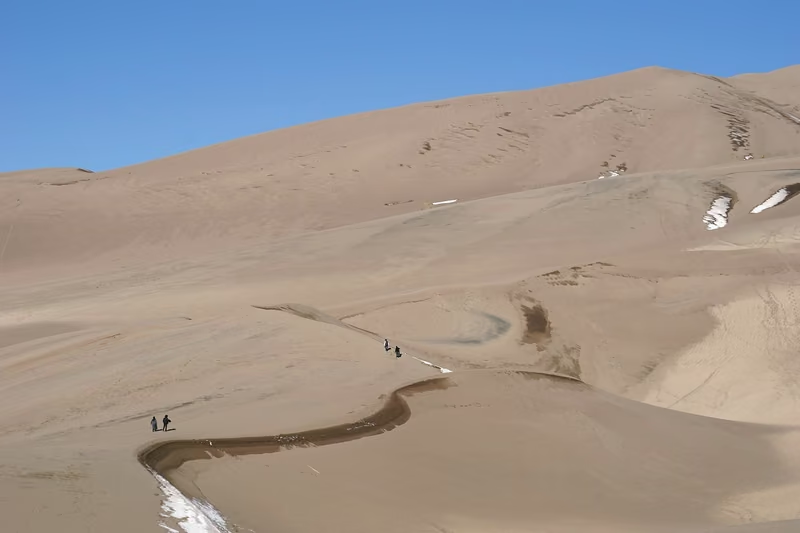
Photo: RJA1988 on Pixabay Medano Creek surge flow
The creek flows along the base of the dunes in spring. The Park Service says late May and early June are the best time for surge flow, when waves flow across the sand, and that in average or wetter years the waves can carry children on small flat inflatable toys for short distances.
USD 25 per private vehicle, covering all occupants; USD 20 per motorcycle (valid 7 days); USD 15 per person aged 16 and over on foot or by bicycle. Children under 16 on foot or bicycle need no pass. Vehicle and motorcycle fees are credit or debit only at the entrance station.[3]Standing season in an average year: the creek usually reaches the Dunes Parking Area sometime in April, peaks in late May or early June, and recedes in July, with a shallow flow near Castle Creek Picnic Area through August and September. The conditions page gives mid May to early June for flow past the main parking area. Not all years have enough flow for floating or surge waves.[24][22][26] Current conditionsNo reservation is needed. The Park Service says late May and early June weekends are very crowded, with long traffic lines and full campgrounds, and recommends weekdays. Mosquitoes emerge in mid-June.[24][26]Official site
Visitor center and park video
The visitor center offers ranger help with trip planning, Junior Ranger books and badges, exhibits on the region, a large ecosystem diorama, a night sky video, a 3D valley model and a 20-minute park video. Flush toilets and a water fill station are in the lobby during open hours.
USD 25 per private vehicle, covering all occupants; USD 20 per motorcycle (valid 7 days); USD 15 per person aged 16 and over on foot or by bicycle. Children under 16 on foot or bicycle need no pass. Vehicle and motorcycle fees are credit or debit only at the entrance station.[3]The visitor center is open daily 9:00 to 4:30 all year, closed on Thanksgiving, Christmas and New Year's Day. The park charges vehicle fees only when the entrance station is open in spring, summer and fall, or when the visitor center is open in winter.[4][3] Current conditionsNo reservation is needed. The visitor center is at 11999 State Highway 150, Mosca.[28]Official site
Night sky over the dunes
Great Sand Dunes is certified as an International Dark Sky Park. The Park Service says August and September give some of the best night skies, to view at least 1.5 hours after sunset or before sunrise on moonless nights, with a red light only and no phone flashlight. No lights illuminate the parking areas or dunes.
USD 25 per private vehicle, covering all occupants; USD 20 per motorcycle (valid 7 days); USD 15 per person aged 16 and over on foot or by bicycle. Children under 16 on foot or bicycle need no pass. Vehicle and motorcycle fees are credit or debit only at the entrance station.[3]The Park Service says the park is open 24 hours a day, 7 days a week, year round. Temperatures drop at night even in summer; the Park Service lists warm layers, snacks and water, and says black bears and mountain lions are active at night, mainly in forested areas.[4][29] Current conditionsNo reservation is needed. Note where the Dunes Parking Area lies relative to the cottonwood trees so you can find your vehicle.[29]Official site
Medano Pass Primitive Road
A rough 22 mile road linking the park with the Wet Mountain Valley and Colorado State Highway 69, crossing Medano Creek nine times and reaching Medano Pass at 10,040 feet. The Park Service gives an average drive of 2.5 to 3 hours.
Park entrance applies: USD 25 per private vehicle, covering all occupants; USD 20 per motorcycle (valid 7 days); USD 15 per person aged 16 and over on foot or by bicycle. Children under 16 on foot or bicycle need no pass. Vehicle and motorcycle fees are credit or debit only at the entrance station. The Park Service lists no separate fee for driving the road.[3][23]The road fully opens when weather and road conditions allow, typically in mid to late May, and typically stays open through the end of the fourth rifle hunting season, near the end of November. Roadside camping is available late spring through fall.[23][4] Current conditionsA high-clearance 4WD vehicle with a 4L transfer case setting is required; AWD and 2WD vehicles are prohibited between Medano Pass and the Point of No Return. Roadside camping sites are free and first come, first served, with no permit.[23]Official site
Mosca Pass Trail
A trail in the foothills, 3 1/2 miles (5.7 km) one way. The Park Service says to allow 2 to 3 hours to reach the pass.
USD 25 per private vehicle, covering all occupants; USD 20 per motorcycle (valid 7 days); USD 15 per person aged 16 and over on foot or by bicycle. Children under 16 on foot or bicycle need no pass. Vehicle and motorcycle fees are credit or debit only at the entrance station.[3]The Park Service says the park is open 24 hours a day, 7 days a week, year round. The monthly conditions page says high-elevation trails are still snowy in May and under snow in December.[4][26] Current conditionsNo reservation is needed for the park; the trail description lists no permit.[1][3]Official site
Free ranger programs
Ranger-led programs on the many aspects of the park, held in the visitor center, the amphitheater and occasionally at trailheads. Topics vary, and free school programs are requested through the Education page.
Programs are free; the park entrance fee still applies: USD 25 per private vehicle, covering all occupants; USD 20 per motorcycle (valid 7 days); USD 15 per person aged 16 and over on foot or by bicycle. Children under 16 on foot or bicycle need no pass. Vehicle and motorcycle fees are credit or debit only at the entrance station.[30][3]The Park Service says programs are offered primarily in summer and fall; the park calendar lists the schedule and locations.[30] Current conditionsPrograms are listed as free, with schedules on the park calendar.[30]Official site
Photographing autumn colour and snow on the dunes
The Park Service names groves of yellow aspens above the dunes at peak colour in late September, cottonwoods along Medano Creek in mid-October, snow on the dunes about once a week in winter, prairie sunflowers on the dunefield in mid to late August, and the Milky Way in the evening in late summer and early fall. It advises against light painting at night.
USD 25 per private vehicle, covering all occupants; USD 20 per motorcycle (valid 7 days); USD 15 per person aged 16 and over on foot or by bicycle. Children under 16 on foot or bicycle need no pass. Vehicle and motorcycle fees are credit or debit only at the entrance station.[3]The Park Service says the park is open 24 hours a day, 7 days a week, year round. The Park Service calls peak Medano Creek flow in early June of a good runoff year the most popular and most crowded time of year.[4][31] Current conditionsNo reservation is needed. The Park Service suggests a telephoto lens from near the visitor center for the aspen groves.[31]Official site
First 48 hours
- Before you fly
Apply for the ESTA only at esta.cbp.dhs.gov (USD 40.62). No park reservation is needed, but pick the season first: Medano Creek runs in spring, the sand is dangerously hot on summer afternoons, and Piñon Flats is open April through October.
- Arrival day
Fly to Denver (DEN) or Alamosa (ALS) and hire a car; the park is 234 to 242 miles from Denver and 37 miles from Alamosa. Use the park area map or a Colorado highway map rather than a phone map for mountain highways.
- Arrival evening
Reach the visitor center, open daily 9:00 to 4:30, and watch the 20-minute park video. Pay the entrance fee by card.
- Day two, early morning
Hike High Dune on the first ridge before the sand heats up, allowing 2 to 4 hours, then rent a sled or board outside the park if you want to slide.
- Day two, evening
Return for the cool sand and, in late summer, the night sky: the park is open 24 hours, there are no lights on the dunes, and the Park Service asks for a red flashlight only.
Travel medical cover is sold by the week. SafetyWing
Where to stay
Alamosa
The nearest town of any size, with the small airport the Park Service names.
The Park Service gives 37 miles from Alamosa to the visitor center, by US 160 east and State Highway 150 north, or State Highway 17 north and County Lane 6 east from Mosca, and lists drive distances rather than times.[17]
Piñon Flats Campground
The in-park campground, open April through October and closed November through March, with 88 individual sites and no hookups.
Sites are booked on recreation.gov or on 1 877 444 6777 up to 3 months ahead. Individual sites are USD 20 a night; check-in is after 2 pm and checkout at 1 pm. There are flush toilets and a campground store, and no showers.[18][4]
Stays in these areas can be compared on one site. Expedia
Airport to city
Denver International Airport[17] DEN
San Luis Valley Regional Airport, Alamosa[17] ALS
If the page says a car helps, compare hire prices before you land. Discover Cars
When to go
Warmest month July, average high 81°F (27°C). Coolest month January, average low 11°F (-11°C).[25]
All 12 months
| Month | Weather | Crowds | Holidays | Closures |
|---|---|---|---|---|
| January | Highs 33.4 F (0.8 C), lows 11.3 F (-11.5 C), 0.58 in (15 mm) of precipitation, about 2 days with 0.1 in or more.[25] | Quiet.[26] | 1 January New Year's Day; 18 January 2027 Martin Luther King Jr. Day.[27] | Coldest month. The Park Service gives highs from the teens to low 30s F and snow that melts off the dunes within days. A 4WD vehicle can usually reach Castle Creek Picnic Area, and the rest of Medano Pass Primitive Road is closed for winter.[26] Current conditions |
| February | Highs 38.8 F (3.8 C), lows 16.2 F (-8.8 C), 0.44 in (11 mm) of precipitation, about 1 day with 0.1 in or more.[25] | Quiet.[26] | 15 February 2027 Washington's Birthday.[27] | Dry, with snow on the dunes about weekly and melting within a day. Winter access on Medano Pass Primitive Road is as in January. Sandhill cranes arrive in the San Luis Valley for about 6 to 8 weeks.[26] Current conditions |
| March | Highs 48.5 F (9.2 C), lows 23.7 F (-4.6 C), 0.88 in (22 mm) of precipitation, about 3 days with 0.1 in or more.[25] | Spring break crowds, and Dunes Parking can fill on busy weekends.[26] | Volatile weather and the snowiest month on average; afternoon winds are common, so go in the morning. Medano Creek is still mostly frozen on the east side and starts to trickle toward the Dunes Parking Area. Cranes peak in early March and are mostly gone by the end of the month.[26] Current conditions | |
| April | Highs 55.8 F (13.2 C), lows 29.2 F (-1.6 C), 1.19 in (30 mm) of precipitation, about 4 days with 0.1 in or more.[25] | Moderate.[26] | Windy afternoons, so go in the morning. Medano Creek usually reaches the Dunes Parking Area, low at first and a few inches deep by late April. Piñon Flats Campground opens around early April and Medano Pass Primitive Road may still be closed beyond Castle Creek.[26][24] Current conditions | |
| May | Highs 65.9 F (18.8 C), lows 37.8 F (3.2 C), 1.19 in (30 mm) of precipitation, about 3 days with 0.1 in or more.[25] | Late May weekends are extremely busy, and Piñon Flats is usually full most nights.[26] | 31 May 2027 Memorial Day.[27] | Medano Creek peaks in late May, with surge waves up to about 20 inches, and the Park Service calls late May and early June the best time for surge flow. Medano Pass Primitive Road is usually fully open by late May, and high-elevation trails are still snowy.[26][24] Current conditions |
| June | Highs 77.4 F (25.2 C), lows 47.6 F (8.7 C), 0.73 in (19 mm) of precipitation, about 2 days with 0.1 in or more.[25] | Early June weekends are very crowded.[26] | 18 June 2027 Juneteenth (observed).[27] | Creek flow is near peak in early June and declines to about 1 inch or less by late month. Afternoon storms begin and the sand can reach 150 F. Mosquitoes emerge in the second week, for about 4 to 7 weeks depending on water levels.[26][24] Current conditions |
| July | Highs 80.8 F (27.1 C), lows 51.7 F (10.9 C), 2.10 in (53 mm) of precipitation, about 6 days with 0.1 in or more.[25] | Heavy traffic.[26] | 5 July 2027 Independence Day (observed; 4 July falls on a Sunday).[27] | Medano Creek is a trickle that dries at the Dunes Parking Area, with about 1 inch along the east edge near Castle Creek. Afternoon thunderstorms are frequent and the sand reaches 150 F.[26] Current conditions |
| August | Highs 78.1 F (25.6 C), lows 50.0 F (10 C), 1.92 in (49 mm) of precipitation, about 6 days with 0.1 in or more.[25] | Heavy traffic.[26] | The creek is dry at the Dunes Parking Area all month. Afternoon storms continue and the sand can reach 150 F. Prairie sunflowers peak in the last two weeks, and clear moonless nights give some of the best Milky Way viewing.[26] Current conditions | |
| September | Highs 71.6 F (22 C), lows 43.5 F (6.4 C), 1.31 in (33 mm) of precipitation, about 3 days with 0.1 in or more.[25] | Traffic decreases.[26] | 6 September 2027 Labor Day.[27] | Some of the best weather of the year. Early in the month the sand can still reach 150 F. Aspens turn gold, peaking late September to early October at lower groves.[26] Current conditions |
| October | Highs 59.6 F (15.3 C), lows 32.8 F (0.4 C), 0.86 in (22 mm) of precipitation, about 3 days with 0.1 in or more.[25] | Lower traffic.[26] | 11 October 2027 Columbus Day.[27] | Chilly nights and pleasant days, especially early in the month. First snow typically falls on the dunes late in the month, and cottonwoods along Medano Creek peak in mid-October. Piñon Flats Campground closes at the end of October.[26] Current conditions |
| November | Highs 45.5 F (7.5 C), lows 21.6 F (-5.8 C), 0.51 in (13 mm) of precipitation, about 2 days with 0.1 in or more.[25] | Visitation drops, with Thanksgiving weekend somewhat busy.[26] | 26 November 2026 Thanksgiving; in 2027, 11 November Veterans Day and 25 November Thanksgiving.[27] | Early winter, with pleasant afternoons on the dunes. Medano Pass Primitive Road is open weather permitting until the end of hunting season, typically just after Thanksgiving. Some cranes stay through November. Piñon Flats Campground is closed November through March.[26] Current conditions |
| December | Highs 34.1 F (1.2 C), lows 12.0 F (-11.1 C), 0.49 in (12 mm) of precipitation, about 2 days with 0.1 in or more.[25] | Quiet except holidays.[26] | 25 December 2026 Christmas Day.[27] | Coldest weather, with sub-zero lows possible and snow about weekly; the sand is firmer and partly frozen, and afternoons are warmest. Roads are usually cleared quickly and higher trails are under snow.[26] Current conditions |
What things cost
| Item | What it costs |
|---|---|
| Park entrance, private vehicle | USD 25, covering all occupants[3] |
| Park entrance, motorcycle | USD 20 (valid 7 days; up to 2 motorcycles and 4 passengers)[3] |
| Park entrance on foot or by bicycle, per person aged 16 and over | USD 15[3] |
| Great Sand Dunes annual pass | USD 45 (US citizens and residents)[3] |
| America the Beautiful annual pass, resident | USD 80[3] |
| America the Beautiful annual pass, non-resident | USD 250[3] |
| Piñon Flats Campground, individual site, per night | USD 20 (April through October)[18] |
| Sand sled or sandboard rental | Hired outside the park; the Park Service lists no prices[21] |
Safety
The sand surface can reach 150 F on sunny summer afternoons. The Park Service says to explore the dunes in early morning or evening in summer, and describes afternoon thundershowers as common in July and August, with lightning strikes common and sometimes fatal. Leave the dunes promptly if a storm approaches.[2][1][21] Current conditions
The visitor center, campground and dunefield sit at 8,200 feet and the dune summits reach 8,700 feet (2,650 m).[2][1] Current conditions
The Park Service advises against using computer mapping programs for highway travel in the Rocky Mountains and recommends the park area map or a Colorado highway map.[17][22] Current conditions
Medano Pass Primitive Road needs a high-clearance 4WD vehicle with a 4L setting, and AWD and 2WD vehicles are prohibited beyond Medano Pass. The road crosses Medano Creek nine times, there is no cellular service, and emergencies are 911.[23][24] Current conditions
Sand Creek Lakes need a 4WD drive of about 2.5 hours from the visitor center and an 8 mile (13 km) round trip hike; the Park Service says snow may block these trails from November into June and that Sand Creek is uncrossable in early summer, generally all of June.[1] Current conditions
Scams to watch for
Common mistakes
Myth: Medano Creek runs every summer.
Actually: In an average year the creek reaches the Dunes Parking Area in April, peaks in late May or early June, and recedes toward the mountains in July, when the main visitor area usually dries. The Park Service says not all years have enough flow for floating or surge waves, and that snowpack changes the depth and duration. The conditions page gives mid May to early June for flow past the main parking area in an average year.[24][22][26]
Myth: You can walk the dunes barefoot or in sandals.
Actually: The sand surface can reach 150 F on summer afternoons. The Park Service recommends high-top boots with long pants, says sandals chafe, and advises hiking in early morning or evening to avoid burned feet and heat exhaustion.[1][2]
Myth: Any sled, board or piece of cardboard works on the dunes.
Actually: Sandboards and sand sleds are made for sand. The Park Service says snow sleds, snowboards and skis only slide on very wet sand after rain or snow, and cardboard, saucers and soft plastic dig in or drag.[21]
Myth: The park rents sleds and boards.
Actually: The Park Service does not rent sleds or boards, so they must be hired before arriving. It lists shops in Mosca, Blanca, Hooper and Alamosa, and the Great Dunes Oasis Store about 4 miles away, with seasons that differ.[21]
Myth: The dunes are walked on a marked trail.
Actually: The dunes have no trails, so you can go anywhere in the dunefield. The Park Service says third-party hiking apps are often inaccurate and to plan from its own distances.[1]
Myth: Any car can drive Medano Pass Primitive Road.
Actually: High-clearance 4WD vehicles with a 4L transfer case setting are required, and AWD and 2WD vehicles are prohibited beyond Medano Pass. ATVs and UTVs are not permitted in the park or preserve.[23]
Sources
Show all sources (31)
- Great Sand Dunes National Park and Preserve: hiking and backpacking, National Park Service.
- Great Sand Dunes National Park and Preserve: weather and sand temperatures, National Park Service.
- Great Sand Dunes National Park and Preserve: fees and passes, National Park Service.
- Great Sand Dunes National Park and Preserve: hours and seasons, National Park Service.
- Visa Waiver Program, US Customs and Border Protection.
- Electronic System for Travel Authorization (ESTA), US Customs and Border Protection.
- Western Hemisphere Travel Initiative (WHTI) frequently asked questions, US Customs and Border Protection.
- Certain DHS immigration-related fees required by HR-1: fiscal year 2027 adjustments for inflation (Federal Register, 1 October 2026), US Government Publishing Office (Federal Register).
- Visa Waiver Program, US Department of Homeland Security.
- Travel advice and advisories for United States, Global Affairs Canada.
- Bringing agricultural products into the United States, US Customs and Border Protection.
- Denominations, US Currency Education Program (Federal Reserve Board).
- Prepaid, Verizon.
- AT&T Prepaid plans, AT&T.
- United States eSIM, Airalo.
- eSIM USA, Holafly.
- Great Sand Dunes National Park and Preserve: directions, National Park Service.
- Great Sand Dunes National Park and Preserve: Piñon Flats Campground, National Park Service.
- USA travel advice, UK Foreign, Commonwealth and Development Office.
- CBP warns against third-party site use for ESTA applications, US Customs and Border Protection.
- Great Sand Dunes National Park and Preserve: sandboarding and sand sledding, National Park Service.
- Great Sand Dunes National Park and Preserve: alerts and conditions, National Park Service.
- Great Sand Dunes National Park and Preserve: Medano Pass Primitive Road, National Park Service.
- Great Sand Dunes National Park and Preserve: Medano Creek, National Park Service.
- US climate normals 1991 to 2020, monthly: Great Sand Dunes NP and Preserve, CO (USC00053541), NOAA National Centers for Environmental Information.
- Great Sand Dunes National Park and Preserve: conditions to expect each month, National Park Service.
- Federal holidays, US Office of Personnel Management.
- Great Sand Dunes National Park and Preserve: visitor center, National Park Service.
- Great Sand Dunes National Park and Preserve: experience the night, National Park Service.
- Great Sand Dunes National Park and Preserve: free ranger programs, National Park Service.
- Great Sand Dunes National Park and Preserve: photography, National Park Service.